

The Churchill Crocodile
Updated: May 4, 2023
Written by Jack Que
Edited by Bryan Carmichael and Elisabeth Lean

As far as weapons warfare goes, dubbed the British version of the Tiger (a German heavy tank), the Churchill had been one of the main battle tanks used by the Allies during WWII. This tank came with a seventy-five millimetre turret and two machine guns, which proved to be very effective in battle throughout the African campaign and later, the advancement into Europe. However, what if such a battle machine were to be combined with another terrifying product of the war: the flamethrower? Through this, one of the most effective weapons of the war was made, surpassing even the nuclear bombs made by the US – the Churchill Crocodiles.
Although it was an incredibly effective flamethrower tank, that alone was not what made it special. Many other concepts of a flamethrower tank exist, such as the conversion of the American Sherman tanks (also used by the Allies during WWII). The most important difference between the two is that the Crocodile's flamethrower is fueled via an external fuel tank on a trolley, instead of being contained within the tank, like the Sherman. The external fuel tank has the same protective armour as the main tank and contains two fuel tanks along with cylinders of pressurised nitrogen gas that provide pressure required to propel the fuel. On the outside, the armour does its job well to protect against light firearms.
On the inside, the fuel goes through a pipe that travels down the underside of the tank, sheltering it from enemy fire. It is then directed to a turret (in place of one of the Churchill’s machine guns), which is then lit via a torch positioned next to the mouth of the nozzle. All of these combined create a combat vehicle that retained its main attacking features as a tank – the main turret and machine gun – while adding on its excellent flame-throwing ability.

What are the capabilities of the flamethrower? The external fuel tank of the Crocodile holds a total of 400 gallons, or 1818 litres, of fuel. Its optimal fuel is not conventional gasoline, realised by both the US and the UK. A sticky, thicker fuel that is far more effective, as it sticks to the enemy as well as increases the firing range of the flame. All of these combined gave the Churchill Crocodile a maximum range of 150 yards/137 metres, a maximum effective range of 120 yards/110 metres, and a total firing duration of eighty seconds. To put that in perspective, it has six times the range of an average one-man flamethrower, contains 200 times more fuel, and can fire for eight times as long. This makes the Crocodile the most powerful mobile flamethrower of WWII.
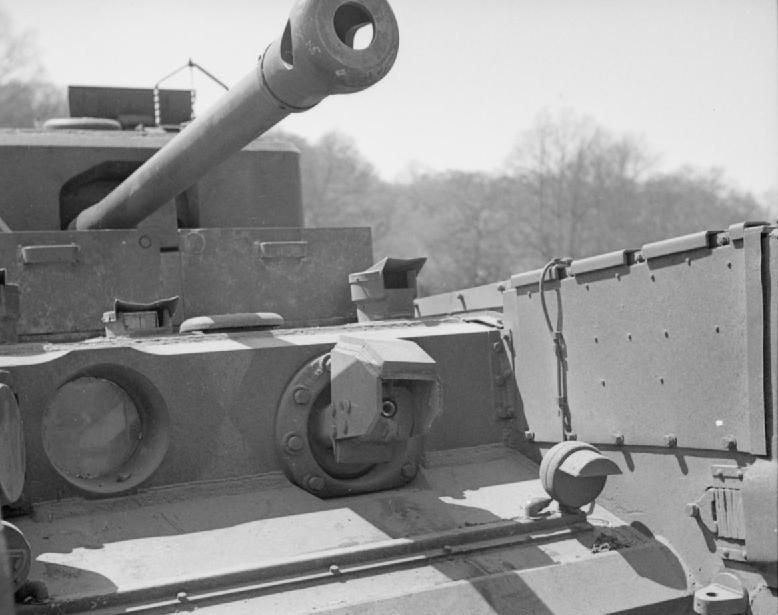
Holding such a large amount of fuel with the extremely high pressure of many nitrogen canisters could be seen as a massive weakness in the design. When facing the Germans’ giant eighty-eight millimetre anti-tank gun, these Crocodiles are nothing more than potential fireballs. As such, fighting against eighty-eight millimetres was not what the Crocodiles were meant to do. Instead, they shined against highly fortified positions, such as bunkers and trenches, where there were far lower chances of containing eighty-eight millimetre AT guns (the expensive eighty-eight millimetres were unnecessary in a place where large amounts of low calibre AT weapons could be stored).
To create the maximum amount of shock to the German positions, the Crocodiles were meant to rush towards the defensive positions backed by infantry until within range to suddenly open fire upon them. Ideally, they would flood trenches with sticky burning fuel or shoot flames through the gaps and slits for gun placement in bunkers, wreaking havoc. The flamethrower was accurate enough to quickly and accurately shoot through bunker gaps with just two shots of flame (according to a study of thirty-one missions). With this, they were able to continuously break through enemy lines quickly. According to the same study, when Crocodiles were present, the missions had a success rate of ninety percent.
The above is the proper doctrine on how to best use the Churchill Crocodile: to shock the enemy. However, being a flamethrower, the fear of instantly being burnt to death was much more intimidating than facing bombardment. The Germans were so scared of the flame tank that they often surrendered with few casualties inflicted, and according to the ‘thirty-one missions study’, around 5000 German soldiers surrendered with only 250 casualties. At this point, we can already see the effectiveness of the tank, demonstrated by the fear it brings to its enemies, as well as its ability to psychologically disable troops allowing for an early German surrender.
However, if the doctrine above is followed, the psychological mentality might flip. If the tank is so close that enemy flanking is possible (with the ‘thirty-one missions study’ suggesting that singular soldiers are hard to hit by the flames), the tank operator may be forced to kill those in their vicinity, triggering the self-preserving feel in the enemies to resist with all their will. Not being given the opportunity to surrender would lead to unnecessary deaths and casualties on both sides.
Moreover, it was discovered that not following the doctrine of going for shock and surprise and instead trying to ‘advertise’ the fear of the Crocodiles by opening fire before the enemy comes within range and showing off the deadly nature of the tank to tease the enemy into surrendering quickly was more effective. Other strategies were used, including sprayed unignited fuel onto the enemy, and allowing the enemy to consider their circumstances (guaranteed death if they resisted), then waiting for their eventual surrender.
Despite its overwhelming success, there are also failure stories. For example, the tank going up in flames from unexpected eighty-eight millimetre AT guns, or simply forgetting to bring the Churchill Crocodiles.
Bibliography:
1. UK_National_Archive. Analysis of Operational Use of Churchill Crocodile flamethrowers in NW Europe, June-October 1944. 1944, www.normandywarguide.com/archives/analysis-of-operational-use-of-churchill-crocodile-flame-throwers. Accessed 12 Jan. 2023.
2. The Tank Museum. “Tank Chats #55 Churchill Crocodile | The Funnies | The Tank Museum” YouTube, 2019, www.youtube.com/watch?v=dfTZEsMh0oM. Accessed 12 Jan. 2023.
3. Lindybeige, Lloyd. "The most effective weapon of World War Two." YouTube, 2022, www.youtube.com/watch?v=GpIoqyjWvzI. Accessed 12 Jan. 2023.
4. Murray, Leo. War Games. Jaico Publishing House, 2019.


Comments